
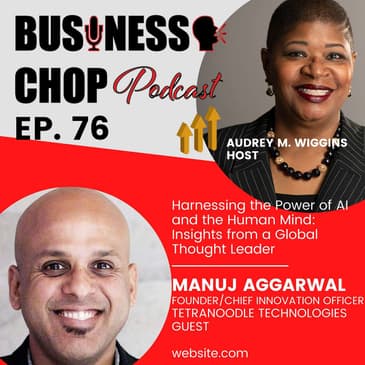


In this episode of “Business Chop," host Audrey Wiggins introduces her guest, Manuj Aggarwal, an expert in artificial intelligence (AI). Manuj shares his journey from humble beginnings as a factory worker to becoming a global thought leader in AI. He discusses his impactful technology projects, patents in AI, and books on technology.
Audrey asks Manuj about the origins of AI and its impact on society. Manuj explains that AI has been in use for decades, revolutionizing industries like healthcare, education, and e-commerce. He emphasizes the recent democratization of AI, making it accessible to everyone through tools like Chat GPT. The conversation delves into the potential of AI to disrupt jobs and its role in improving efficiency across various sectors. Manuj addresses concerns about AI replacing human jobs, highlighting the historical shift from labor-intensive work to more creative and enjoyable roles.
Switching gears, they discuss the power of the mind and neurodiversity. Manuj advocates for mindfulness practices like meditation and visualization to harness the potential of human intelligence alongside AI. He suggests using AI-generated stories to create positive thoughts and manifest desired outcomes. The episode concludes with insights into the symbiotic relationship between technology and human consciousness, showcasing the transformative possibilities when combined effectively.
Learn more at ManujAggarwal.com
Connect with Manuj on LinkedIn https://www.linkedin.com/in/manujaggarwal and join the community of high-achievers who are changing the world and defining what it means to be truly successful.
Follow his YouTube Channel Bootstrapping Your Dreams
Join us April 27, 2024 at the Elevating the U in Entrepreneur Business Summit. Visit bit.ly/ElevateUApril24 for information and registration. Don't miss out!
Buzzsprout - Let's get your podcast launched!
Start for FREE
Designrr for eBooks, Blogs
Create eBooks, Blogs, Lead Magnets and more!
Riverside.fm Your Own Virtual Studio
Professional Virtual Studio
Altogether Domains, Hosting and More
Bringing your business online - domain names, web design, branded email, security, hosting and more.
Digital Business Cards
Let's speed up your follow up. Get a digital business card.
Small Business Legal Services
Your Small Business Legal Plan can help with any business legal matter.
Get Quality Podcast Guests Now
Keep your podcast schedule filled with quality guests from PodMatch.
Disclaimer: This post contains affiliate links. If you make a purchase, I may receive a commission at no extra cost to you.
Please Rate & Review
Visit Our Parent Company Altogether Marketing LLC
Tech Diva Biz Talks is a business marketing and technology podcast exploring innovation, branding, and leadership. Officially indexed on IMDb (2021– ), the show reflects Audrey Wiggins’ work in media production and strategic communications. It is produced by her company, Altogether Marketing LLC. Learn more at altogether.biz.
[00:00:00] Welcome to the Business Chop podcast where our guests speak on meeting the challenges of entrepreneurship,
[00:00:06] as well as offer tips and advice on business, marketing, technology and more.
[00:00:12] Whether you are a newbie or seasoned professional, this episode is for you.
[00:00:18] I am your host, Audrey Wiggins.
[00:00:23] Let's chop it up!
[00:00:30] Hello, Chop Squad. Audrey Wiggins here, your host.
[00:00:33] And this episode is going to be exciting. My guest is an expert in one of the hot topics worldwide.
[00:00:40] I can't wait to share him with you. He's a global thought leader in artificial intelligence.
[00:00:46] He mentors others and serves on boards. He's respected in his community and abroad.
[00:00:52] President Obama and Bill Gates have made special mentions of educational education technology that
[00:00:59] he has delivered. And Miami Dade, the second largest college in the US,
[00:01:05] has listed him among the leading experts in AI. He went from $2 a day as a factory worker
[00:01:12] to being recognized as one of the top 500 global thought leaders in AI and startups
[00:01:18] by Brains magazine. His technology projects have impacted the lives of 10 million people.
[00:01:25] He has four patents in artificial intelligence and he's the author of two books on technology.
[00:01:32] He's the founder and chief information officer of Test Renewal Technologies,
[00:01:37] a premier artificial intelligence and cybersecurity consulting company in Vancouver,
[00:01:43] British Columbia, Canada.
[00:01:54] The tagline, your colors, even the fonts for your business. And then jab left with your website,
[00:02:01] jab right with core values. Back up with product experience and bring it on with you.
[00:02:08] Visit altogether.biz and let us help you create a knockout brand.
[00:02:14] Chop Squad meet Manoj Argawal. Manoj, welcome to the Business Chop.
[00:02:21] Thank you so much for that exciting intro. I'm so honored to be here. Thank you.
[00:02:25] Yes, it's a pleasure and honor to have you here. I want to just dive right in. How did you go
[00:02:33] from $2 a day to the boardrooms of a Fortune 500 company? Let's start there before we get
[00:02:39] into the elephant in the room of AI. Sure, sure. Well, you know, it has been
[00:02:45] quite a long journey. I wish I could say that I had a plan in mind, but it was basically just
[00:02:52] sort of taking one step after the other. And as the cliche goes, just follow your passion
[00:02:59] because earlier on, I recognized that working in a factory is not going to give me
[00:03:04] the life I wanted. And so I needed to build something, some more value in the world so
[00:03:11] that the world can allow me to have the life I wanted. And at that moment, I recognize,
[00:03:17] okay, you know, what is the most valuable thing I can provide? And, you know, technology was
[00:03:23] something I was fascinated with software, computers. It was pretty new at that time.
[00:03:29] I'm talking about 1995-96. So internet was still not available in our city in India.
[00:03:38] But somehow I got some basic education in computers and programming, and I just fell in love with it.
[00:03:45] And since then, you know, for me, it has been a fascinating thing to watch how technology
[00:03:51] changes lives, you know, impacts lives of common people. So, you know, I've done work
[00:03:58] in healthcare, I've done work in education, in real estate, in many, many, many different
[00:04:04] industries. And I see how when we write a simple program on our computer, and then make a copy of
[00:04:11] it on some other person's computer or, you know, a website or something, just by that act like
[00:04:17] how it improves a patient's life, how it improves a doctor's ability to care for patients,
[00:04:24] you know, these kind of things are what drive me, my passion. And I think working on these
[00:04:32] kind of projects over and over and over again led me into boardrooms of Fortune 500, many Fortune
[00:04:39] 500 companies, you know, talking to the CEO, vice presidents, and all kinds of like real, real,
[00:04:47] real successful people, real people with, you know, a mission in life to accomplish things
[00:04:57] and, you know, build wealth, build success. So just interacting with them, learning from them,
[00:05:05] seeing, you know, how this world works, and then back converting those ideas back into
[00:05:11] technology. So it's a snowball effect when you start building your passion,
[00:05:16] you start using your skill to help others get feedback from the marketplace, and then again,
[00:05:22] repeat the cycle, right? Keep repeating it. So that is the exponential growth cycle that
[00:05:27] I've been on. How does it feel to be a global thought leader in artificial intelligence and
[00:05:33] having, you know, the likes of Bill Gates who are, you know, a president, in this case,
[00:05:36] President Obama? They praise the technology that we delivered. They don't know my name.
[00:05:41] They didn't use my name. But the technology that we created was so impactful. Basically,
[00:05:48] the technology we created was to allow university students to complete their degree programs,
[00:05:55] because as we all know, there is a huge student debt problem in our country, right?
[00:06:01] Yes. Yes, that's right.
[00:06:02] And what happens is when students go to universities, many times they find out that
[00:06:09] the courses that they have enrolled in are too difficult for them or they are not very
[00:06:14] interesting to them. And so within the first two years, they say, you know, rather than
[00:06:18] accumulating more debt, I'll just drop out. And so in order to fix that, we created a technology
[00:06:24] that matches the students with the right courses based on their interest, based on their
[00:06:29] aptitude, based on their SAT scores, all of that. And so the result is that those students
[00:06:36] are very, you know, it's quite unlikely they will drop out. And in fact, in real life,
[00:06:43] we see that they actually take 20% more courses to finish their degree program because
[00:06:49] those courses are of interest to them. So this is a patented technology. And when President
[00:06:56] Obama was in office, one of the big pushes was higher education. So he noticed this
[00:07:04] product that we built and he said, you know, he mentioned it several times in his speech.
[00:07:09] And then Bill Gates through his foundation, he also mentioned it in several of his speeches,
[00:07:14] plus Bill Gates invested in this product.
[00:07:20] And now coming back to, you know, how was that experience and being a global thought
[00:07:25] leader? You know, once again, like I believe, you know, I don't have any extraordinary thoughts.
[00:07:33] So for me, being a thought leader is kind of surreal. But what I understand from this word
[00:07:40] or this phrase is that when I talk to other thought leaders, like, you know, the likes of
[00:07:48] President Obama, like the likes of Bill Gates, if my ideas are resonating with their ideas,
[00:07:57] that means that is what a thought leader is, right? Our thoughts are basically resonating with
[00:08:04] people much, much higher up. And so that is the feeling that I'm really proud of. And
[00:08:10] it's still sometimes, it's kind of, you know, doesn't settle in, you know, surreal.
[00:08:16] Exactly. Exactly. Yeah. So and then I get to work with, you know, directly with other
[00:08:24] people who have worked for NASA, who have worked for, you know, large governments,
[00:08:30] who have worked for the UN, you know, standing next to people who have won Nobel prizes,
[00:08:38] you know. So these kind of people, when you find yourself, you know, in the same room,
[00:08:44] on the same stage with them, that's what I think the world calls a thought leader.
[00:08:50] When I look at myself, you know, I just attribute that to the people that I, my name is now
[00:08:58] listed among or, you know, I'm associated with. And that's something definitely I'm proud of.
[00:09:05] But again, it's kind of unbelievable at this point.
[00:09:08] Yeah, I couldn't imagine. For sure. Moving on, today we have chat GPT,
[00:09:16] you know, the generative AI. So that's really opened up the eyes to more, you know, common folk
[00:09:21] who are in business or even employees or young folks just doing things at home writing papers.
[00:09:28] But it didn't just start. Artificial intelligence, we've been using this technology
[00:09:33] for decades. Yeah. Educate us on really where did it come from or how it actually,
[00:09:39] you know, came into being, not where did it come from, but the development.
[00:09:42] Sure. In fact, you know, the very first AI development happened in 1940s, 50s. So,
[00:09:51] you know, we have been, the technology has been around for a long time. The names have changed
[00:09:56] from multiple, you know, it has been given multiple names. But let's talk about the modern
[00:10:03] times. So modern times, you know, when the internet was just coming online in the early,
[00:10:11] late 80s, early 90s. Some people recognize the potential of AI to make really big
[00:10:21] changes in society, really, you know, build large companies. And people like Jeff Bezos,
[00:10:28] people like Bill Gates and some others, they have used this technology over the last 20
[00:10:35] years to build massive companies. So when we say you, we already have been using AI
[00:10:41] absolutely correct. If you have used Amazon to order something and the package shows up on
[00:10:47] the same day or the next day, it is not because Amazon has thousands of employees just waiting
[00:10:53] for your order to come in. You know, it's because they have used AI to really optimize
[00:11:00] the whole supply chain. And even in their warehouses, they have large warehouses storing
[00:11:07] all these goods, right? Right. So when the person who is working in the warehouse,
[00:11:12] they go from one end of the warehouse to the other end of the warehouse, their path
[00:11:19] is also optimized by AI so that they can pick the most orders in the least amount of time.
[00:11:26] Okay. The inventory control, how do you know what price to charge, all this is controlled
[00:11:32] by AI. When we take out our mobile phone, you know, we all carry these devices in our
[00:11:39] every little thing on that device is a result of AI. Right? This meeting that we are recording,
[00:11:46] we are sitting thousands of miles apart. Right? So even about 10 years ago,
[00:11:51] we couldn't have imagined having this conversation face to face on video
[00:11:56] in high definition and real time. Why is it possible? Because AI in the background,
[00:12:02] it is optimizing all the bits and bytes that are going from my computer to your computer
[00:12:09] and vice versa. So AI has been in our lives already for the last 20 years. Now what has
[00:12:17] happened is with chat GPT, you know, so far, as I said, for the last 20 years, people
[00:12:25] who really had the resources, the knowledge, deep pockets, they were utilizing AI to build
[00:12:31] these large companies. Right? Now with chat GPT, it has been democratized, meaning
[00:12:37] it is free. Anybody with absolutely no knowledge of AI can go and interact with this technology
[00:12:43] and they can benefit from it and they can see, okay, you know, how does that impact
[00:12:47] my business? How does that impact my life? Starting from, you know, a five-year-old kid
[00:12:53] who can just play around with chat GPT, ask any question to, you know, science professors
[00:13:00] doing research or lawyers or what have you. And it is available for everyone. So that is the
[00:13:07] shift that has happened recently. I have a question about the chat bots on a website
[00:13:14] and you're asking questions, you know, so you can chat with the bot. Why is it that
[00:13:21] some of them, they really can't, when you ask a question and say, I'm sorry to understand,
[00:13:26] can you rephrase your question? And you keep rephrasing it. You never get an answer. Is
[00:13:31] there any work being done or is it the old garbage in, garbage out scenario?
[00:13:36] Yeah, I think that has been the major breakthrough. Earlier chat bots, they were
[00:13:40] basically just written by rules. So, you know, some engineer and a business person sat
[00:13:48] down together and said, okay, let's list down, you know, most frequently asked questions. And
[00:13:54] they may come up with like 10 or 15 questions. And then they say, okay, you know, if somebody
[00:14:00] asks something outside of this, just ask the chat bot to say, I don't know what you mean.
[00:14:04] Like just, you know, explain it to me. Now with chat GPT, it has actually, it has learned
[00:14:10] the entire written, written by humanity. Basically starting from the beginning of time till today,
[00:14:18] it has, you know, gone out there and read everything and understood how humans talk to
[00:14:24] each other. So now with that technology, even if it doesn't understand, it can pick up certain
[00:14:29] hints. It can pick up certain contexts, some nuances, and then based on the intelligence it
[00:14:36] has created in itself, it can start to guide us so that, you know, we, it doesn't say, oh,
[00:14:42] I don't understand you. It will say, do you mean something like this? You know, I don't really
[00:14:47] understand you, but I think given the context, this is what you mean and so on and so forth.
[00:14:53] So that is the breakthrough in the level of intelligence that has happened. So new chat
[00:14:58] bots that are going to come out, which will incorporate chat GPT, OpenAI, all these new models,
[00:15:05] they will be much more intelligent. In fact, you know, we have developed technologies where
[00:15:11] these AI models can actually make phone calls to people and have intelligent conversations,
[00:15:18] just like humans do in the business context and say, okay, you know, for example, if you,
[00:15:23] if you're an insurance company, if you're a small business owner, if you,
[00:15:27] you know, any kind of business scenario where you need to interact with your customers,
[00:15:33] your prospects or what have you, rather than hiring a whole bunch of like
[00:15:38] people making these calls, AI can do that today.
[00:15:42] Okay. All right. So that brings up another question about is AI going to take over
[00:15:49] humanity? Because I can remember in the factories when they were putting in, you know,
[00:15:55] robotics, you know, to perform certain tasks. And so now we're at another level with AI. Can
[00:16:01] you speak to that? Yeah. So see, you know, jobs are going to be disrupted, but I had a very
[00:16:08] interesting conversation just recently with one other pioneer in AI.
[00:16:31] People will find some disruption in their jobs, but let's look at history. Right. So for the
[00:16:40] majority of our history, you know, human life has been just around survival. We used to work
[00:16:47] in the fields all day long, every waking hour. 99% of humans used to work in the field just
[00:16:54] to feed ourselves. Right. Yes. And then modernization came, factories came, you know,
[00:17:00] cost of goods went down, availability of food became ubiquitous. Like everywhere we can find
[00:17:07] food now easily rather than working seven days a week. You know, we were introduced to five
[00:17:14] day work week, you know, working conditions improved and people who were able to upskill,
[00:17:20] they found better and better and better jobs. Right. So now, you know, with robotics,
[00:17:28] it's not like people are not needed in the automotive industry or manufacturing industry.
[00:17:34] Their job became from labor intensive doing work with hand to just monitoring the robots
[00:17:41] and making sure that nothing is wrong. That level of intelligence, that level of sort of
[00:17:49] understanding of the real world that is not going anywhere. That will always remain with humans.
[00:17:55] Okay. But the mundane work, you know, like all this drudgery of work that is being offloaded
[00:18:02] to the machines. So now coming back full circle, when we say, oh, you know, I'm afraid that
[00:18:10] AI will take away my job. If I ask somebody, how will you like to win the lottery?
[00:18:17] Yeah. You know, and they'll say, oh yeah, you know, that is my dream. Like if I win the
[00:18:20] lottery, I will not work. I'll just go lie on the beach and just, you know, have drinks all
[00:18:26] day, enjoy my life. And the idea is that that's what AI is here to promise because it will
[00:18:34] reduce the cost of goods. It will create jobs which are more enjoyable, which are, you know,
[00:18:39] more sort of creative in nature and fun in nature that the definition of work itself is
[00:18:47] going to change. Oh, wow. I never thought about it like that. Shifting gears a little bit. I know
[00:18:52] you're into, you know, the power of your mind and neurodiversity, different concepts, something
[00:18:57] we haven't heard about. So how can we use the power of our mind to achieve anything?
[00:19:03] So we're talking about artificial intelligence. Let's talk about our human intelligence.
[00:19:07] Yeah. So human intelligence, you know, this is no secret that basically our thoughts that we think
[00:19:15] over and over again, they become our beliefs. And these beliefs are what guide us subconsciously.
[00:19:21] You know, our subconscious mind is 90% of what we experience in life. And in most cases,
[00:19:29] we don't understand what is happening in our subconscious mind. Research has shown that each
[00:19:34] human thinks about 60 to 90,000 thoughts per day. Okay. And 90% of those thoughts are negative,
[00:19:42] like, you know, they are self criticizing, they are, you know, just negative thoughts, right?
[00:19:48] So if we start to utilize methods like meditation or yoga or Tai Chi, or, you know,
[00:19:58] there are many, many, many disciplines around the world, which help us understand what is
[00:20:05] happening in our mind. And it's almost like when we get into these methodologies,
[00:20:12] our conscious mind can become the observer of our subconscious mind and you can say,
[00:20:18] Oh, look, this is a negative thought. Let me replace it with a positive one.
[00:20:23] Okay.
[00:20:24] And the fact is that AI can actually be very effective here by planting a positive thought.
[00:20:31] So, you know, one exercise I always recommend to people is, let's say you want to achieve
[00:20:36] something in the next 30 days. Let's say you want to go on a trip with your kids or,
[00:20:42] you know, you want to get some sort of promotion that you're applying for,
[00:20:48] pass your exam, whatever. What I tell people is just go to AI and ask it to write a very
[00:20:56] descriptive story of how it will feel like once you have achieved that goal. So,
[00:21:02] you know, just say, okay, so let's say if you want to go to a picnic with your family,
[00:21:08] to a nice destination, describe that destination, describe the weather,
[00:21:12] describe the food you're having, describe the people around you and then ask AI to,
[00:21:18] you know, sort of write a story in the first person in the present tense and read it out
[00:21:25] to yourself. That will really help you visualize that and plant those positive thoughts in your
[00:21:33] mind. And it's spooky and you will be pleasantly surprised at the outcome because I always tell
[00:21:43] people try it and let me know how it went. And then, you know, it's just like when people
[00:21:49] come back to me and say, oh, you know, I cannot believe what happened, you know,
[00:21:53] when I was doing it. So it's like form of a meditation on steroids. So, you know,
[00:21:59] combining technology, the power of mind, all of these methods are so fascinating and they
[00:22:07] are so powerful. Very easy to implement. Absolutely. Now you talked about traveling.
[00:22:14] Why is it important for us to travel? Travel, you know, like again, our mind is always
[00:22:22] seeking new experiences, new impressions. In general, humans did not evolve to stay in one
[00:22:28] location. We are originally in the cave man days like we were gatherer, hunter, hunters,
[00:22:35] you know, we had to roam the land to figure out where to get our food. So even when we
[00:22:44] look at the history, you know, major improvements have been made by humans who were explorers. They
[00:22:51] went out there and found new lands, met new people, tasted new foods. What that does is
[00:22:58] it expands our horizons in our mind and tells us what is possible because absolutely there is
[00:23:05] no limit to what humans can achieve. And we have proven that, you know, in very short
[00:23:11] period of time we have become the most dominant species on this planet. Why is that? Because
[00:23:19] we are always pushing the limits of what is possible and that when you travel, you find new
[00:23:25] ways of living. You find new solutions to similar problems. At the fundamental level,
[00:23:32] humans, we all have similar problems. You know, in our lives, we want prosperity,
[00:23:37] we want abundance, we want like, you know, happiness for our families, food, water,
[00:23:42] all these things, right? Basic stuff. But when we go to Australia, you know, they'll solve
[00:23:48] this problem differently. When we go to Indonesia, they'll solve these problems differently.
[00:23:53] When we go to, you know, Europe, they'll solve this problem differently. And the other thing
[00:23:58] is a lot of history of these places teaches us again, how did this region evolve? You know,
[00:24:05] what were people like? And when you assimilate all that in your mind, again,
[00:24:11] it expands your horizons. There is no substitute to that.
[00:24:14] All right. So as we expand our horizons and we're more open to this, we're going to bring
[00:24:19] it right back to technology. Yeah, yeah, yeah.
[00:24:24] Yeah, absolutely. So is there anything else to share about business and technology in general?
[00:24:31] I know a lot of us, you know, sometimes y'all want to be a millionaire and not necessarily from,
[00:24:36] you know, hitting the lottery. You mentioned that. What is the fastest way to do that?
[00:24:42] Yeah, I think one thing I always teach people is look into a concept called Ikigai. It's
[00:24:50] a Japanese concept. And many people, you know- Can you repeat that? What's the concept again?
[00:24:56] Ikigai. Ikigai. I-K-I-G-A-I. So the idea here is that, you know, we get the massive success in
[00:25:07] our life when we find our true purpose, when we are fulfilled, when we are happy doing what
[00:25:13] we are doing. And just like I mentioned earlier, many people get into, you know, things
[00:25:19] which are of no interest to them. You know, like I mentioned, university students getting into
[00:25:26] programs which are of no interest to them. So even in life, we say, oh, you know what? Oh,
[00:25:32] my cousin is really successful being in the automotive industry. So let me go into automotive
[00:25:38] industry or what have you, right? But my passion could be music. My passion could be
[00:25:44] art or whatever. So Ikigai really helps you narrow down what it is that you are really good
[00:25:51] at, what it is that the world is going to pay you for, what does the world need and what makes
[00:25:58] you happy. So once you find an intersection of that and you start to focus on that skill or
[00:26:06] that passion that you have, things become automatically very, very easy and success
[00:26:12] becomes faster and quicker. And then we can take advantage of that AI to help us along the
[00:26:17] way. Exactly, exactly. Yeah. What other concepts or trends in AI do you want to share with us today?
[00:26:24] Trends, you know, things are moving so rapidly. Just yesterday or day before, OpenAI released a
[00:26:32] new platform which can convert your text into high definition video. So now you can create,
[00:26:40] you can use AI to create text, images, video, and this will continue, you know, I think in the
[00:26:46] next five to ten years. It is expected that AI is going to add about $10 trillion to the
[00:26:52] world economy. So $10 trillion is obviously $10,000 billion and this is the biggest
[00:26:58] wealth making opportunity. And the reverse of that is that, you know, it's also predicted
[00:27:05] that if businesses don't use AI within the next five to seven years, they will be obsolete.
[00:27:11] They will not be competitive enough to survive. This is a very huge turning point in human history
[00:27:17] and I believe, as I said earlier, the definition of work is about to change. I predict that,
[00:27:22] you know, in five to ten years, there will be public companies listed on stock exchanges
[00:27:27] with one employee, which will be the rest will be done by AI. Even today, if you go to
[00:27:36] cities like San Francisco, Phoenix, there are driverless cars driving around and you can just
[00:27:42] call them with your mobile phone. So these kind of changes, these are very, very drastic
[00:27:48] changes in human society and they are going to happen in a short period of time. So I
[00:27:55] just want people to be ready and embrace this change and take benefit of it rather than be
[00:28:01] victims of it. Yes, absolutely. Now how can we get in touch with you and so we can learn more
[00:28:07] and sit at your feet, so to speak? Yeah, yeah, absolutely. So we are giving away a lot
[00:28:12] of free content. I have prepared some free video series for people to get started on AI.
[00:28:18] Reach out to me on LinkedIn or my website, manujagarwal.com or there is another
[00:28:24] website called AImerge.pro or Google my name. I'm very easy to find, just reach out and let
[00:28:32] me know that you would like to learn more about AI. You want the free stuff that we
[00:28:37] distribute to people and we'll be happy to help. Awesome. Really appreciate that,
[00:28:43] Manuj and thanks again for coming today. Absolutely. Thank you so much.
[00:28:47] Yeah, you're welcome. All right, Chop Squad, you've got your orders. Definitely. This is
[00:28:52] one we can't afford to miss because it's going to pass us by if we don't. So definitely go to
[00:28:58] Manu's, find him on LinkedIn, get in touch with him and what was the other website?
[00:29:04] AImerge.com. AImerge.pro, sorry. AImerge.pro. Okay, all right. Well,
[00:29:11] thanks again and we'll see you next time. Thank you for listening to another episode of The
[00:29:16] Business Chop. It is my hope that you were able to glean usable information from today's
[00:29:21] episode and that you will download and share this podcast. Be sure to plug into our guests,
[00:29:27] go through their website and social media channels to see how they can help you further
[00:29:31] through their products and services as well as plug into our website, alltogether.biz,
[00:29:36] where we will help you expand your brand.
Resources
Some of the resources here are affiliate links. We may receive a small commission if you buy or subscribe. It does not affect the price you pay.

BUZZSPROUT. The best way to launch a professional podcast.

RIVERSIDE.FM. Professional Remote Content Creation Studio

DESIGNRR. Get Instant Transcripts from your Podcast, Video, or Webinar

ALTOGETHER DOMAINS. Online Solutions for Domain Names, Hosting, Website Security, Email Marketing & more