
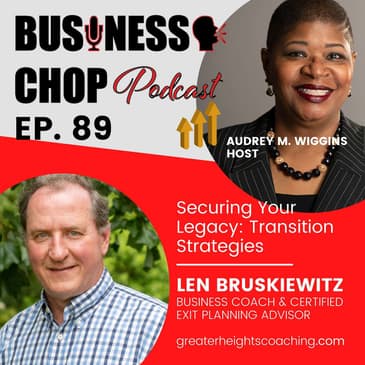


In this episode, we sit down with Len Bruskiewitz, a renowned Business Coach and Certified Exit Planning Advisor, to discuss the critical importance of having an exit plan for your business. With over 3 million of the 6 million companies with 1-19 employees in the US owned by individuals aged 55+, the lack of a transition plan can put businesses, families, employees, customers, vendors, and communities at risk. Len specializes in helping business owners generating $1-10M in revenue plan and execute successful transitions on their timeline and terms. Discover how Len's expertise leads to a significant reduction in stress and a substantial increase in the value of their company. Whether planning to pass your business to a family member, sell to a third party, or transition to employees, Len's insights will guide you towards a smooth and successful exit. Don't miss this essential conversation on securing your legacy and ensuring the future of your business.
Learn more.
greaterheightscoaching.com
Visit: bluesky.valucompass.com/advisors/YhD0irFnvb2eq4PZ/discover - this is a 15-20 minute assessment that gives a business owner a rough idea of what their business is worth and the areas they need to work on to increase the value.
Buzzsprout - Let's get your podcast launched!
Start for FREE
Designrr for eBooks, Blogs
Create eBooks, Blogs, Lead Magnets and more!
Riverside.fm Your Own Virtual Studio
Professional Virtual Studio
Altogether Domains, Hosting and More
Bringing your business online - domain names, web design, branded email, security, hosting and more.
Digital Business Cards
Let's speed up your follow up. Get a digital business card.
Small Business Legal Services
Your Small Business Legal Plan can help with any business legal matter.
Get Quality Podcast Guests Now
Keep your podcast schedule filled with quality guests from PodMatch.
Disclaimer: This post contains affiliate links. If you make a purchase, I may receive a commission at no extra cost to you.
Please Rate & Review
Visit Our Parent Company Altogether Marketing LLC
Register for our Elevating the U in Entrepreneur virtual business summit
Tech Diva Biz Talks is a business marketing and technology podcast exploring innovation, branding, and leadership. Officially indexed on IMDb (2021– ), the show reflects Audrey Wiggins’ work in media production and strategic communications. It is produced by her company, Altogether Marketing LLC. Learn more at altogether.biz.
[00:00:00] Welcome to the Business Chop podcast where I guest speak on meeting the challenges of entrepreneurship as well as offer tips and advice on business, marketing, technology, and more. Whether you are a newbie or seasoned professional, this episode is for you. I am your host, Audrey Wiggins.
[00:00:23] Let's chop it up! Hello Chop Squad. Welcome again to another episode of the Business Chop. I'm excited for our guest today. And our guest is a business coach and certified exit planning advisor, Meet Len Brushkiewitz.
[00:00:44] He helps business owners generating anywhere from $1 million to $10 million in revenue plan and execute a successful transition of the company to either family member, third party, or even an employee on their timeline
[00:00:58] and their own terms. Over $3 million of the $6 million companies with 1-19 employees in the U.S. are owned by people aged 55 plus. And the vast majority of them do not have any kind of transition plan in place. Working with Len helps them in two ways.
[00:01:18] A huge reduction in stress and a significant increase in the value of their company. Now we're going to learn more about Len on the other side of this message. Len, before we get into our questioning, I just want to welcome you again to the Business Shop.
[00:02:03] Thank you. I really appreciate being here, Audrey. I'm really looking forward to sharing some information with your viewers and listeners. Awesome. Yeah, we're ready to learn. We've got our pencils and, well, not our pencils and papers, but our technology so we can take notes, okay?
[00:02:19] Or just re-record it. Tell us about one or two fun things or achievements that you have. Yeah, I had a long career in high tech over 30 years and I worked almost exclusively for companies that targeted small businesses.
[00:02:34] So I really feel like I understand what a small business goes through. I'm also a third generation business owner. So I've lived it. My grandparents both owned businesses, my parents and now me. So I feel like I understand what business owners are going through.
[00:02:51] And a quirky little fact about me is I wake up two mornings a week at 5.30 in the morning to play ice hockey.
[00:02:58] So as you can see, I'm not exactly the youngest of people but I absolutely love getting out and playing hockey and I do it early in the morning. I just really enjoy it. Get that blood flowing and ideas creeping in. That's great.
[00:03:15] Exactly. So how does that serve you waking up and playing that ice hockey? It does a couple things. One, it gets exercise out of the way early for me and I feel really good the rest of the day.
[00:03:29] It just gets me going. The second piece is it's a great networking opportunity for me. So I play with a bunch of people who are lawyers and accountants and doctors and engineers and business owners.
[00:03:43] So it's really a good place for me to meet other business owners, share ideas with them and potentially even get some clients out of it. Wow, that's great. Yeah, I like that because that is, yeah, that's a little double hitter right there. I like that.
[00:03:58] Get your exercise out of the way and you meet some folks in networking because networking is very important to us as business owners. Absolutely. Yeah, we have to keep our pipelines filled and just keep your minds fresh. I think meeting new people does both of those things.
[00:04:13] Right off the top, what are the five top reasons that us business owners don't create an exit strategy? Yeah, I think there are a couple that are really important. The first reason is I think business owners think it's complicated and it kind of scares them.
[00:04:34] So that's one that can be dealt with pretty easily because you can do it in pieces. You don't have to get it all done at once. But that's one of the biggest reasons I hear as to why business owners don't do it.
[00:04:46] The second reason that they don't do it is they think that they're just going to run their business forever. And I don't know about you, but that really hasn't worked out for anybody yet.
[00:04:58] So there is going to be an end date and it's really much better to have a plan than not have a plan. A third reason is that it's really hard for some business owners to get separation from their business.
[00:05:14] I'll give you examples. So think of the business owners and I'm sure there are lots of them that are part of your community. They not only run their business, but they're a huge part of the communities they live in.
[00:05:28] So it's not only them that they impact. They impact their families, their employees, their customers, their vendors, and most importantly, their community. Think about who sponsors the float in the parade. Think about who's giving money to the local high school for their club or things like that.
[00:05:48] So that's hard to get rid of because a lot of business owners see that as a major part of their identity. So that inability to kind of separate is another big reason that business owners don't do it. The fourth reason I'll give you is they don't know how.
[00:06:06] So you can find lots of courses of how to start a business, how to run a business. You don't find many that say, hey, this is how to get your business ready to exit. So I think that's a fourth reason.
[00:06:18] And the fifth reason is it goes back a little bit to what I want when I talked about earlier. It's almost like buying life insurance. You know you need it, but you don't really want to think about it and you think you can always put it off.
[00:06:32] So I think those are some reasons why people don't do it. Taking that leap and go for years and years. So when do you think we should start thinking about that and actually not just thinking about it, but the plant OCs and have a plan? Yeah.
[00:06:48] What I recommend in terms of a timeline is at least two years in advance, the longer, the better. But really it takes about two years to kind of get things in place because you really want to be ready.
[00:07:04] And again, if you're thinking of selling, potential buyers are going to have a lot of questions. And taking that two years gives you time to get your processes in order to get your accounting records in order to get your kind of management structure in order.
[00:07:20] So that's what I recommend. And staying that the whole idea isn't to say, I know it's going to be in two years. The whole idea is being ready at any point in time. So I don't think about exit planning as having necessarily a specific date.
[00:07:38] I think about it as being ready so that if something comes along or if you just want to do something different, now your business is ready.
[00:07:44] How do you choose how you want to exit, whether it's selling it, bequeathing it or just passing it on to a family member or the employees? And if it's the employees, do you do it while you're still working in the business? Yeah. There are a lot of options.
[00:08:01] And one of the biggest issues that came out of a survey of about 3,000 small businesses in the U.S. is that 60% of business owners don't even understand what all their options are. So you've hit on just about all of them.
[00:08:18] But what I like to do with somebody that I'm starting to work with is to sit down and walk them through each option. And you've hit them, succession, selling to a third party, selling to employees. There's also potentially selling to partners or competitors.
[00:08:35] And there's always the last one out there is just shutting down the business. And I don't like to see that, but that may be the best solution for some owners.
[00:08:45] So what I really do is sit down with a business owner and walk through the pros and cons of each. There are lots. And then just let them decide. To some, a legacy is really important. And so then shutting it down isn't really their plan.
[00:09:01] And maybe even selling it to a competitor doesn't really maintain your legacy, but a succession plan to a family member, employees, that may be a better fit. So it's really about what their goals are and that leads to what the options are.
[00:09:14] You mentioned earlier about business closes or when they're fully operational, that they're part of the community. And some of our businesses are invisible except to our clients. For instance, like my new marketing branding, it's really, it's not a brick and mortar where folks are coming up.
[00:09:34] It's not a dry cleaners or retail type institution or even a restaurant. So for those types of entities, if they did do the latter of shutting down, as you mentioned, it kind of shuts down part of the legacy of the community more so.
[00:09:54] But I would argue that even those, you know, the businesses that you talked about still impact clients, customers, vendors, right? Partners that they work with and their family. So there's still, it's more than typically more than just the business owner that's impacted when a business closes down.
[00:10:13] Does every type of business need a next strategy? I would argue almost all do. I'll give you one exception. So I have a friend who's also done work for me. He's a Mason, right? So he's helped me rebuild the brick wall and do some working on my house.
[00:10:35] It's just him. And so his kids, they're not interested in his business. He doesn't own anything but a truck and some tools. For him, I kind of argue doesn't really need an exit plan. When he's done, he's going to sell his truck and that's going to be it.
[00:10:53] But almost everybody else needs one because again, there's greater impact on their family members. And one stat that I want to share with everyone is that for the majority of business owners, 80% of their financial assets are tied up in their business.
[00:11:10] So if you think about that, yeah, if you think about that just shutting down, you're kind of limiting, you know, you're putting a big cap on your network. So really trying to harvest that value that you've built up over time is, I think, really important,
[00:11:27] especially as you look ahead and say, what do I want to do next? Being able to increase the value of business and then be able to get that out can make a huge, huge difference in people's lifestyle after they sell. Right. Absolutely.
[00:11:44] And then if something was to happen to them, you know, then those assets can, you know, be going filtered over into, you know, to their family members. Exactly. Exactly. So I have a, I'll keep it really short, but I have a case study of a friend of mine.
[00:12:01] Unfortunately wasn't a client, but a really successful lawyer built a practice up over 15 years had no exit plan whatsoever. He did everything himself. Unfortunately, he got ill and died. And his family knew nothing about what was going on with the business.
[00:12:18] They had to bring in forensic accountants and lawyers and lots of professionals to figure out what was going on with the business. They didn't know how much he owed people. They didn't know how much he was owed.
[00:12:30] They didn't have any sense of what was going on with his taxes. And so this ended up costing them over $70,000 just in professional fees. Yeah. A big amount that could have gone to the estate, but instead because he had no plan, they literally had no idea.
[00:12:47] And that's an extreme example. Right. Most people have some kind of plan, but you know, it was certainly traumatic to the family that a they had to go through this and that it costs so much to get done.
[00:13:00] What contributes to the most value of a business when it is sold? Even while it's not so, what are our assets? There's some interesting contributions to the value of a company. I'm going to talk about them in two different ways.
[00:13:16] At the core, the value of a company is based on earnings growth. How much money you're making and how likely that is to continue versus the risk of that not continuing. So it's really about growth and earnings.
[00:13:33] That's how companies are valued and the risk that earnings is going to stop. The higher the risk, the lower the value. In a nutshell, that's how companies are valued. But I'm going to talk about it in another way now.
[00:13:50] If you look at a company from the outside, the things that you can learn about a company without speaking to the owners. In other words, what's their reputation in the industry? How is their industry growing or shrinking?
[00:14:03] Those components that you can see from the outside only contribute about 20% of the value of a company. So one fifth. Four fifths of the value really comes from internal features and they're called kind of intangible assets. They're not things that you can really put your hands on.
[00:14:22] But I'm going to talk about real quickly, they're kind of for them and we call them the four C's. So there's human capital, which is the people. How good are the people that work there? There's structural capital, which is the processes. How good are your accounting records?
[00:14:43] Those kinds of things. Customer capital, which is the third C, which is regarding how diverse your customers are they're paying? Are they committed to you? Do they buy from you frequently? That's customer capital.
[00:14:58] And then the fourth is social capital, which is really what's the culture of your company? Do people like being there? Do they like working there? So those are the things that contribute fully 80% of the value of a company.
[00:15:11] So I hope that helps kind of describe how companies are valued and how they can be built. Again, you can build value without having to sell, right? Doing all those things is going to yield a better operating business.
[00:15:26] Lynn, what are some of the pitfalls for us to avoid when thinking about selling our business? Yeah, I'll give you a couple. The biggest pitfall is really not having good accounting records.
[00:15:40] So if you can't come in and show the history of your business in terms of accounting records, huge pitfall. And if we go back a couple questions, you said how long?
[00:15:53] Two years because it can kind of take you a couple years to unwind some things and clean some things up. So that's one big pitfall is kind of bad accounting records and lack of documentation of how your business runs to huge pitfalls. So that's two.
[00:16:12] Accounting records, lack of document processes. The third, and this is a real killer, is the owner not being able to separate themselves from the business. Huge issue.
[00:16:26] So I'll throw another stat out for you of all the private deals that get right to the end and then fall apart. 75% of those deals fall apart because the owner got cold feet. The older owner backed out, the seller backed out at the last minute.
[00:16:44] And the biggest reason that they back out is because they don't know what they're going to do next. They don't have their plan. And because of that, they say, well, I'll just revert to what I know. Right? I'll revert to just keeping running the business.
[00:16:59] So that is that not having a kind of a personal plan, I think is a huge pitfall of being, you know, of not being able to sell.
[00:17:14] And the fourth one, fourth and final is not having kind of a management structure that can take over and run the business after you're gone. It's related to that not being able to separate. But really you have to have people, and it might only be one or two.
[00:17:29] I'm not talking about massive companies, but you need others who can do, can run the business when you're not there. So those are my pitfalls. Okay. Yeah, well, those are very important.
[00:17:42] And then especially that last one about because you're almost alluded to like being a solo pernure, we've got to have someone working with us that knows what's happening. Exactly.
[00:17:53] So I have a friend, one of the guys I play hockey with was talking to him yesterday and I said, I said, what happens when you go on vacation? And he said, I'm still working. I still nobody else can run things.
[00:18:07] And I said, you've got to fix that because you can't sell your business. So that's an example where doesn't have that separation and it would be a huge pitfall if he tried to sell a business. Yeah.
[00:18:20] I've often heard that when you're talking about the section or exit plans and selling your business is that you don't go with the new owner. They don't even want us, they don't want the queue to go to their operation. Yeah, I mean, that's kind of the right, right?
[00:18:41] If they're paying the money, they get to call the shots. And it's funny because what my experience is that a lot of business owners want to stay involved because they think they need to be.
[00:18:51] And that's problematic because the owners, new owners get to call the shots and the old owners are saying, well, that's not the way I did it. It's too bad. You've got to check. You don't get to say anymore.
[00:19:08] So I recommend that if you've got that independence and you can walk away and get on to your next thing. Yeah, so that's important. That's almost the same as retirement from an employer. We do need to have a plan like what are we going to do?
[00:19:25] We're all excited about coming to the end. And I guess it's a little different when you're a business owner and that's all you've done. It's like, I don't know anything. I'm not really leaving quote unquote a job.
[00:19:37] So yeah, I can imagine we really have to really focus on that and I would say probably sooner rather than later like I said. And to be honest with you, in my intro you talked about how I focus on older business owners because there's a greater need.
[00:19:54] But even if you're young, you should be thinking about how you're going to exit your business because you'll set things up. Better and maximize the value if you think about it up front of how you want to exit rather than waiting.
[00:20:08] The time is now and it's a lot of us baby boomers out there. That's, yeah, so there's the data that you mentioned at the beginning over half the business owners in the US are 55 and up.
[00:20:20] And ironically, based on the same survey data that I mentioned earlier, I'm in this generation as well. I didn't think you were. I thought you were younger and you don't look as old as I do.
[00:20:33] But the generation that's 55 and up is the least prepared to transition their businesses, which is there's irony there because they're the closest to needing to, but they're the least prepared. And that's why I've focused on them. Although, like I said, every business needs to be thinking about this.
[00:20:52] That's right because we aren't going to be doing it forever. Nobody has yet. Just ask those folks out here. Hopefully they won't answer, but you know, but we can pretend to ask them as a potential buyer. What value are they looking for? How do they value our business?
[00:21:14] What they do is they look at those external factors first, right? And then they typically look at internal factors. But really, most businesses that are in this in the category I talked about the kind of one to 10 million.
[00:21:29] Those businesses are valued based on a multiple of their earnings. All right. So if you think about net income, basically think about how much you take home at the end of the day. And then there's some addbacks to that.
[00:21:43] So things like interest, taxes, depreciation, as well as any personal expenses that a owner runs through their business. Those get added back as well. And so you get this kind of it's called EBITDA earnings before interest, taxes, depreciation, amortization.
[00:22:02] And so when you get that number, typically then a multiple is applied to that number. And for businesses, typical businesses, it's maybe two to four times the earnings. So that's normally how businesses get valued.
[00:22:18] But then if you think about that 80% I talked about those intangibles, that can take the multiple from, let's say, the two to four range. That can take it down to zero.
[00:22:30] It can take it's businesses are unsaleable or it could take it up to maybe eight or 10, depending on how well the business is run. But really, if you ask where do most businesses end up that kind of two to four times their annual earnings.
[00:22:46] What nuggets of advice do you have for us? Bring it together, everything you've kind of shared with us. Looking forward, maybe there's a couple of categories or just lay it on us.
[00:22:59] Yeah. Yeah. So there I'm going to come back to the couple of things I mentioned earlier with some very specific things. The first piece is focus on a growth strategy. Potential buyers love companies that are growing. Okay, and I'm going to be pretty precise about this.
[00:23:20] They care less about companies that are growing their revenue than they do companies that are growing their earnings, their profit. Potential buyers care much more about earnings than they do about revenue. So focus on growing your earnings. So that's really my big one.
[00:23:35] And the nugget in there is you may, as you look at your business, there may be sources of revenue that are not generating any profit. Maybe it's an old customer or first customer until you have an affinity for them. That buyer doesn't care about that.
[00:23:51] So pare down and really the nugget is focus on the things you're really good at and then try and grow from there rather than trying to expand what you're doing. So that's my first nugget. My second nugget is document your processes.
[00:24:06] So one of the cool things that's happening now, that used to be writing down SOP standard operating procedures, right? Yes. That's boring. What a lot of clients that I'm working with now are starting to do is record videos.
[00:24:21] So they'll record a video and say, this is how this process happens. It's a lot easier to do than typing out words.
[00:24:30] So that's a big one. Document your processes because again, it's going to be important when you sell, but it might allow you to take a vacation that you couldn't take today. So having that is like a huge stress reduction, right?
[00:24:46] The third tip is going to be about making sure that you're developing people that can run the business after you're gone. Whether that's a management layer or just some key employees, figure out what motivates them.
[00:25:01] Get them excited about being involved with the business after you're gone because that's going to be key. A potential buyer is going to come in and say, okay, what about your people?
[00:25:11] And again, it might only be one or two. But if you can say they're well trained, they're motivated, they love this place. They want to see it continue to thrive and grow. That's going to be a huge value as opposed to the opposite.
[00:25:24] And then my fourth one, this is again nothing new. Figure out what you want to do next as a business owner. One of the first questions a potential buyer is going to ask you is, what are you going to do once you sell the business?
[00:25:38] And I'll give you some really bad answers and then I'll give you a good answer. A really bad answer is, I'm going to travel and play golf. That is not a plan, right? Right, exactly.
[00:25:52] So a good answer would be something along the lines of, you know what, my grandkids are in Arizona. I'm planning to move to Arizona and I'm going to start a nonprofit that helps ABCD. That's a plan, right?
[00:26:09] And it doesn't need to be that complicated but it's absolutely the question you're going to be asked is what are you going to do next? And if you don't have a good answer, potential buyers are going to hit the exits.
[00:26:21] So figure out what that next thing is because again, that's going to help you get that separation, which is really important not just for potential buyer, but it's important for you as well.
[00:26:33] Absolutely. Wow, that was a lot of wisdom right there. I'm glad this is recording and not the last lecture because I'm sure some of our notes would have been stopped. Hopefully I didn't talk too fast.
[00:26:47] Oh no, no, no, you didn't talk fast at all. Really, I appreciate it and you bringing your expertise in because this is an important subject.
[00:26:55] It really is. And so I'm sure the CHOP Squad or anyone else who's listening would definitely appreciate it and that being said, how can we get in touch with you and tell us about getting to your website and things like that?
[00:27:12] Yeah, I'd say that's the best place to start.
[00:27:16] My website is greaterheightscoaching.com, so greaterheightscoaching.com and up in the right hand corner for anybody who owns a business who's just curious about, you know, I wonder what this thing is worth and I wonder what's kind of holding me back.
[00:27:32] I've got a business valuation calculator up in the right hand corner. Oh great. Yeah, it's free. It takes about 10 minutes to go through. It requires very little financial information, just a couple numbers and you're picking at your industry.
[00:27:46] It's going to give you an estimated value of what your company is worth today. It's not a professional, you know, evaluation but it's a rough guess.
[00:27:55] And then it's going to give you some areas of the things that you would need to work on to increase the value of your company. So it's a great starting point for a conversation just to have a sense.
[00:28:08] And if, you know, if anybody wants to have a conversation after that there are plenty of ways to contact me from my website.
[00:28:15] But that's what I would recommend is everybody take a look at that calculator. It's fun to go through. It's not hard and it really just gives you a place to start.
[00:28:24] I like that. Well, Lynn, there's nothing else. I really appreciate you coming today and educating us absolutely not just sharing but educating us. Oh, it was a pleasure. I appreciate you inviting me. Thank you.
Resources
Some of the resources here are affiliate links. We may receive a small commission if you buy or subscribe. It does not affect the price you pay.

BUZZSPROUT. The best way to launch a professional podcast.
RIVERSIDE.FM. Professional Remote Content Creation Studio

DESIGNRR. Get Instant Transcripts from your Podcast, Video, or Webinar
ALTOGETHER DOMAINS. Online Solutions for Domain Names, Hosting, Website Security, Email Marketing & more