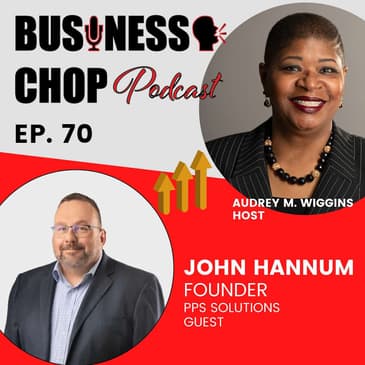


Our guest is the Founder and CEO of PPS Solutions. His name? John Hannum.
This episode reviewed the role of a CFO and the importance of financial planning and strategy in business operations. John Hannum, the founder of PPS Solutions, provided insights into the differences between a CFO, CPA, and bookkeeper, emphasizing the scarcity of CFOs compared to the high demand for financial acumen in small businesses. The conversation also explored the evolution from entrepreneurs managing all aspects of their business to the need for specialized financial expertise as companies expand. Hannum stressed the importance of understanding finance as a fundamental aspect of business growth and sustainability.
He also touched on the benefits of finding a CFO to work with and the importance of vetting candidates for industry experience and understanding of financial concepts. Hannum underscored the significance of regular interaction for businesses to maintain financial stability and the need for access to a CFO during crucial decision-making. The conversation also delved into the personal business backgrounds of the participants, with John sharing his formative experience working in his parents' business and the impact it had on his career trajectory.
Finally, they discussed the development of the subscription model for PPS Solutions and the satisfaction Hannum derives from seeing entrepreneurs and businesses succeed. The conversation emphasized the collaborative nature of finance and the importance of having a financial perspective at the table for better results and planning in business operations.
-----------------------------------------
PPS provides a strategic partnership to business leaders as well as administrative support to take the burden of running a business off the entrepreneurs who should be out growing the businesses they’re passionate about.
FOR A CONSULTATION VISIT ppsfinance.com
Buzzsprout - Let's get your podcast launched!
Start for FREE
Designrr for eBooks, Blogs
Create eBooks, Blogs, Lead Magnets and more!
Riverside.fm Your Own Virtual Studio
Professional Virtual Studio
Altogether Domains, Hosting and More
Bringing your business online - domain names, web design, branded email, security, hosting and more.
Digital Business Cards
Let's speed up your follow up. Get a digital business card.
Small Business Legal Services
Your Small Business Legal Plan can help with any business legal matter.
Get Quality Podcast Guests Now
Keep your podcast schedule filled with quality guests from PodMatch.
Disclaimer: This post contains affiliate links. If you make a purchase, I may receive a commission at no extra cost to you.
Support the show
Please Rate & Review
Visit Parent Company Altogether Marketing LLC
Tech Diva Biz Talks is a business marketing and technology podcast exploring innovation, branding, and leadership. Officially indexed on IMDb (2021– ), the show reflects Audrey Wiggins’ work in media production and strategic communications. It is produced by her company, Altogether Marketing LLC. Learn more at altogether.biz.
[00:00:03] Welcome to the Business Chop podcast where I guest speak on meeting the challenges of entrepreneurship as well as offer tips and advice on business, marketing, technology and more. Whether you are a newbie or seasoned professional, this episode is for you. I am your host, Audrey Wiggins.
[00:00:25] Let's chop it up. Hello Chop Squad. Great to be here with you again. I'm excited about our guest today and introducing him on this episode. Our guest journey and business started by working in his parents' businesses.
[00:00:39] He saw firsthand the risk and hard work necessary to be a successful entrepreneur. Once he discovered he was pretty good with numbers and systems and got the degrees and certifications to prove it later on, he set out to change the world with the power of finance.
[00:00:57] He built a corporate career in finance and operations and companies that grew like crazy. His first company grew from $175 million to $2.8 billion during his time with service. Since then, every company he has served in has grown exponentially through both organic and M&A activity or mergers and acquisitions.
[00:01:19] A couple fun facts about him. His parents also owned a school of business in Florida and he had the opportunity to be around the shops, quote unquote working from a very young age. He is also an avid biker. That was something exciting to learn about him.
[00:01:35] He's done the charity ride for AIDS Lifecycle. It's a 545 mile ride from San Francisco to Los Angeles. He's done it several times along with other shorter distance bike rides. Now our guest is the founder of PPS Solutions. His name, John Hanham. And welcome to the business job.
[00:01:57] Thank you so much, Audrey. Thank you for having me. Absolutely. We're going to hear more from John on the other side of this message. Knock out your competition with all together marketing. We elevate your brand.
[00:02:09] Take a stance with your business name, logo, the tagline, your colors, even the funds for your business. And then jab left with your website. Jab right with core values. Pick up with product experience and bring it on with you.
[00:02:25] Visit alltogether.biz and let us help you create a knockout brand. This is a very exciting conversation. Numbers can be exciting, right? Numbers are great. I think we're going to be able to do enthusiasm on that.
[00:02:41] Some people, it's nap time, but I get excited by numbers every day. Yeah, so I'm excited to hear what you have to say because, and we really should be because if we don't know our numbers lacking our health, everything can be
[00:02:53] helped to scale to one point that things could absolutely collapse. So first of all, your company, I know you provide strategic partnerships to business leaders as well as administrative support. So helping us to take that burden off of our shoulders so we can do what we do best
[00:03:10] and as a grow our business, sell our products and services. So let's start with what is finance to a business? Yeah, that's a great question. And it's kind of the core of what the service that we offer is.
[00:03:23] We offer finance and that represents itself in the idea of a CFO and maybe accounting and some other things beneath that. Obviously big companies have huge finance departments and there's hundreds and hundreds of people in finance departments that I've worked in.
[00:03:39] Each one has its own specialized space, but the idea of finance really is just about numbers, right? It's talking through the language of numbers about the rest of the operations, especially in entrepreneurial businesses. Entrepreneurs have to wear a lot of different hats.
[00:03:55] They have to be marketing and sales and operations and innovation and administration. Every single one of those has a number behind it. So finance relates to every single part of the rest of the business. It's just talking about it through that language of numbers.
[00:04:11] Finance is just thinking of the money perspective of things. It's the intersection of thinking about money with all those other disciplines. And to me, we offer that service of allowing that entrepreneur not to think about the money behind it, right? An entrepreneur has a vision.
[00:04:28] Maybe they're really specialized into the marketing or innovation approach. Maybe they're really good at operations. You know, whatever those spaces they're not good in though, their service is available that can help them to create that. And that's what PBS Solutions does. OK, so then what's the difference then?
[00:04:44] Because we do our own bookkeeping. We might have a CFO or a CPA. So what's the difference there? Well, these are the that's a great question. So the typical trajectory is you're your your own entrepreneur into where all the hats until all of a sudden you're too busy.
[00:05:01] So you get rid of some administration, right? You you hire a bookkeeper or you have a CPA external that's going to worry about your tax returns, etc. So most of my time is actually educating people on how finance
[00:05:15] is really different than your CPA or bookkeeper, both of which are really important spaces, important people within that within the ecosphere. You can't do good things without good books. So, you know, it's the basis of accounting, but you also don't want to be
[00:05:32] asking your bookkeeper about whether you should be hiring a new sales manager or opening a new warehouse, you know, new distribution channel, product innovation, all of that kind of thing. So your CFO, whether it's full time or part time fractional, really is a person
[00:05:47] that you take all of your financial questions to and partner that it helps you answer those. You know, the the CFO thinks differently a little bit than your bookkeeper, your bookkeeper and your accountant are going to think, how does this go into the tax return at year end?
[00:06:05] You know, they just don't have the experience tools or strategic perspective to give that operational financial perspective. And that's where I think the real difference is. Of course, good finance, as I mentioned, does start with great accounting. So you have to have a good accounting.
[00:06:23] You know, in a lot of ways bookkeepers operate in a tax only scenario, a cash basis. So really thinking about your books as a source of numbers that are going to help you manage the business might be useful to as a place to start for accounting.
[00:06:39] The bookkeeper is going to probably think about putting like commission expense. If you have commissions that you pay in February for January sales, you know, those hit the tax return in February, not January. So the bookkeeper would put those in February in a cruel accounting
[00:06:57] system and thinking about numbers for operational use. Those commissions relate to sales in January. So they should be put in January and accrued into January. So just thinking about the accounting and numbers from a different perspective is the basis for good accounting and good finance.
[00:07:17] After you have good accounting and your numbers are kind of reflective of the operations that you've had for each month, then you can start making a budget, a plan, an idea. And that's where I think the magic starts happening. That's the fun part, huh? It is.
[00:07:40] You got into your business to be, to have a vision, right? To accomplish whether that goal is a successful exit, a yacht, you know, your children's college fund, you know, selling it off and starting a new business because you just, you know,
[00:07:54] like the pain and agony of starting businesses. That's also a valid goal. Whatever your goals are, you had a vision and you had a dream. So, you know, what the first idea of finance to that dream is, is creating that plan and that spreadsheet, right?
[00:08:09] A lot of the people that listen to your podcast will understand what a business plan is because they had to create one either for the SVA to get some financing or just because it's a good thing to do.
[00:08:22] You know, that business plan is a written down version of that vision. There's a spreadsheet behind that called a budget or a plan or a forecast or, you know, some type of other word. But there's a spreadsheet behind that that's really kind of important.
[00:08:37] And to the planning and strategy of the company, that spreadsheet is a benchmark. So once you make it, you take all your vision and you assign some numbers to it and you say, OK, here's what we're going to do.
[00:08:48] You can look at that bottom line and understand, is it useful? Is it worth doing what we're going to do? Is it worth the time agony and difficulty of creating this business?
[00:08:59] Do I am I going to get the result that I want to have in the end out of these numbers? And if not, how do I adjust that to make a better plan? OK, you had mentioned the concept earlier, fractional CFO.
[00:09:14] A lot of us may not know what that means. Sure. The fractional CFO is a CFO, in my opinion. A lot of the people that do this in my industry are CPAs that have the financial acumen to add that service
[00:09:27] is kind of an add on service, a monthly subscription, if you will. To me, fractional CFO is a CFO who wants to do wants to use their powers for good rather than to get a fourth vacation home.
[00:09:40] So to me, it's about creating this idea of taking your experience and running larger companies and giving that wisdom and experience to smaller companies who can benefit from it the most. What have you seen small businesses struggle with the most over time? Or over over the years?
[00:10:00] Really, it's it's kind of an interesting question because every business struggles at a different point and, you know, finance, I believe can help unstick from that point. You know, the basics of good accounting, building a budget, you know, marking yourself against that budget and good fiscal governance
[00:10:21] can help you unlock all those difficulties. Some of the difficulties I've seen not being able to be financed. In fact, I have to say through my referral partners, my biggest source of new clients is banks, second big source.
[00:10:39] You know, people that come in and say, here's here are my books. Please give me a loan. And, you know, they're messy or they're they're not able to speak that financial language to the bank. You know, those banks actually refer those those people to me and say,
[00:10:52] you know, have have PPS take care of of your accounting, get your books in order and we create a liaison with that bank to make sure that they can get financed when they go forward. You know, speaking the language of numbers to a bank
[00:11:07] is helps to create the way for that. So you're not getting your business results that you want like a loan. This is a huge difficulty. Yeah, because I thought we need that money, other people's money sometimes to grow. It is true. Some of the things, I mean,
[00:11:25] we look at numbers. So you're not using your numbers as a benchmark and not using them as as a review point, not getting the entire management team on on on the same page regarding the numbers. That's always a big issue.
[00:11:43] You know, monthly each of our clients has a CFO call. We talk about the results. It's very difficult to kind of argue with the numbers when we know they're solid. And so once we put them forward and everybody says, yes, those are the numbers.
[00:11:57] We can decide, A, why they look good or why they look bad and B, what to do about them. You know, what action should we take to improve or you make them better for the next month? So by just having that review aspect of looking at the operations
[00:12:13] through the accounting, I think it makes a huge difference. Otherwise, you have all of your business out there, whether it's as you or 20 people, business out there that's acting in a way that doesn't have a basis in what's actually happening.
[00:12:27] They might assume things are happening one way and the numbers didn't say that. So just having everybody on the same page is a huge help in my opinion. OK, so how is the business management piece working to this?
[00:12:39] Say the numbers aren't as good as they need to be. Or like you said, they didn't, you know, they thought they were better worth their but they're not once they're sitting down in there. You're actually looking at the data.
[00:12:50] So are there recommendations to increase pricing, develop new products or you know, restructure how we do sales? What is the advice there? Or is that something that, you know, that the client has to do internally on their own?
[00:13:08] Well, I think they don't ever have to do it on their own, but all of those are valid levers, right? So if you look at a company that's kind of maxed out in sales, in other words, have 100 percent of the market or a huge portion of the market
[00:13:22] that they're not going to get any more in the sales. You might have to look at at cost reductions or other types of a different market, basically, if you're if you're doing every single thing
[00:13:35] in a market in Los Angeles and you can't grow that way, but you want to grow sales, you might need to move to San Francisco and open a different market or you know, just this is 100,000 ways to do it.
[00:13:47] And by laying the alternatives out and understanding what they are, you can take those actions, but it's specific for every business. And the value of a CFO is they can kind of look at that, make the plan and understand how the business should react to it.
[00:14:03] If we didn't know that we were 100 percent of the market, we might forecast that we're going to grow sales when it's literally not possible, right? Right. Can't do one percent. So, you know, everyone of those is a valid action and
[00:14:18] operations and finance can help make those decisions together, whereas, you know, finance couldn't do it alone and operations couldn't do it alone. Yeah. So how does one prepare or what mindset do we need to have when taking on a fractional CFO? Definitely.
[00:14:37] I know a lot of entrepreneurs that try and understand all the finance themselves. You know, my main point is you don't have to do that. Right? You should understand enough to read a basic P&L, understand what financial concepts we're talking about.
[00:14:50] But, you know, taking on a partner is really it's an act of faith, but it's also something that has an enormous benefits pretty much right away once you find the CFO that you enjoy working with. And that's that should probably be the number one,
[00:15:05] number two right behind experience. But the number one thing about selecting a CFO once you find somebody you enjoy working with, you'll enjoy those benefits right away. What should they know about hiring one? There's a lot of them out there.
[00:15:20] You know, some of them might be your CPA adding that service. You should kind of vet that person to understand, you know, whether they're whether they've had the experience of running businesses before and operating businesses. I think that's a different skill set than just being the CPA.
[00:15:35] It could be that they do have that. So that's great. And then that they have experience within your industry and understand the concepts work with a lot of construction industries. And there's a concept called WIP or work in process
[00:15:48] that people don't work in construction, just don't understand that. So you're having some industry experience is really key to knowing that. So when you interview your your fractional CFO or your fractional CFO firm, you should just talk about your business,
[00:16:04] they'll discover kind of what it's about and what you're about. And you'll discover during that process what they're about and whether they have the record as experience to to handle your business. It's all about confidence because they're going to be a strategic partner going forward.
[00:16:17] OK, OK. Well, that's good to know. So about how much media hours or with your CFO spend with the business or is it just depends on the business size and what their needs are? It really does depend on the size and needs.
[00:16:33] And also what that business needs from the CFO. We operate on a subscription based model, which doesn't have a number of hours attached to it. So if we under scope, we're we're terribly under water. And if we over scope, we haven't provided the right services to that business.
[00:16:50] So I really try when in the sales process to match up what the business needs and what the CFO ability is. But more than that, it's about an access point. So, you know, do we need to talk about the numbers every day and in most growing businesses?
[00:17:08] Probably not. But we do need to have some interaction on a weekly or monthly basis to make sure we're on track. You know, that you might need a CFO on a Friday afternoon when you need to make a big decision. So you need access to that person.
[00:17:21] But you don't want to hire a have a person sitting at a desk that just to be available on Friday afternoons. Right. It's really about access to that service. So, you know, depending on complexity and transaction volume, you know, people always ask what size business I work with.
[00:17:40] And I say, you know, zero to 100 million is probably a good a good space. Three to 20 is probably more likely. But three million dollar business that that makes its money 26 cents at a time is way different than a 20 million dollar business that has one contract. Right.
[00:17:56] It's a transaction velocity, all types of things that might be complex or easier for the CFO to deal with. And we take all that into account when they're when creating the packages. OK, all right.
[00:18:11] So then how can how can one get in touch with you or, you know, with PPS and, you know, to start that journey? Well, our website is ppsfinance.com. PPS is for people process systems. So there's my huge belief that those three things
[00:18:28] in that order have to be accomplished in order to to have success. So ppsfinance.com. There is a link on the website to schedule schedule time with us. That's pretty easy to do. And then my email is johnjohn at ppsfinance.com.
[00:18:45] And those are the two easiest ways to get a hold of us. I love to talk to businesses about finance. So I'd welcome emails and and bookings. I have still now three and a half years into running this business,
[00:18:59] never received a call that from an entrepreneur that said, I woke up this morning and thought I need a fractional CFO. And so, you know, most of my time, I still spend educating people about what we do. OK. That's awesome. But John, what's on this drop
[00:19:17] off a couple of one or two drops of wisdom on us before you leave? But I think, you know, part of the the the benefits of a CFO and I think this is really important. So you're going to run your business for, you know, zero to 100 years.
[00:19:31] Right. And that business is going to do something every one of those years. My firm belief, my 100 percent belief and backed up by, you know, results of 25 plus years now is that that every year you have the finance perspective at the at the table.
[00:19:50] You're going to have a better result. Right. You're going to know your result. You're going to have a better planning. You're going to think about things in a financial way so that over those times you're going to have a better result.
[00:20:02] And that's why the subscription model works as well, by the way, just in general. You know, how did you come up with the subscription model? You know, it wasn't my kind of go back to the history of the founding of the company to wasn't my intention
[00:20:15] to to start a fractional CFO firm. I had left a company in 2020 that we had taken public in 2018. You know, and that was the last kind of we double the size of that company. It was pretty exciting couple years being there, but it was time to go in 2020.
[00:20:33] Were you an employee? Let me interrupt you real quick. Were you an employee or your your owner in that? No, I was employee as a stock marketer, but you know, but employee of the company traditional to standard CFOing. And I think, you know, March of 2020,
[00:20:47] I was going to find a new job and go and do that to another company. You know, every company I had been with had either doubled, tripled or exponentially increased in success. So this was a company that within two and a half years we doubled the footprint,
[00:21:03] took it from one to 14 states, 200 million to 400 million in revenue, you know, different good profitability, etc., and then took it public in the same time. So it was a little bit part of the hollow look in my eyes was was that couple years of work.
[00:21:21] So I figured I would go and do that for another company and, you know, going to get that fourth vacation house someday. Right. And ultimately, I was asked by the person who does my taxes because I don't I don't do my own taxes and very good at it.
[00:21:36] It's a good strategy, but not not execution on the tax side. Person who does my taxes that I have a company that you need to help. I didn't have anything else to do that day. So it's fine. I'll I'll talk to them. They were having a shareholder dispute,
[00:21:50] needed some some financing for a shareholder buyout. And I said, OK, well, it's a, you know, twelve million dollar, thirteen million dollar company. And so it's way too small for me to work with, but I have nothing else to do today, so I'm going to do it.
[00:22:02] And and so through that process, I realized, you know, holy crap, these people that run these sized companies make all these decisions based on instinct and and and kind of gut. And they don't have a finance department. No small CFO would allow
[00:22:21] this company to operate in this way. So I need to fix this. And that's when the light bulb went off and said, oh, I should fix that. I should figure out how to help small businesses. I should do what I do, but just in smaller portions of time
[00:22:35] for some of our businesses. So my first thought, like everybody that enters my space, I think was to do that on a consulting basis. And, you know, so I charge an hourly basis and I went to the office one or two days a week
[00:22:49] and did stuff there and and you work myself into that, then added a few other clients and did the same thing. And what I realized was that that was. You know, we weren't really adding that value. I didn't need to be there all of that time
[00:23:03] once we had organized ourselves appropriately and gotten the shareholder resolved and company is operating correctly. You know, they just needed access to me. They needed to be called on Friday at two and and say, you know, hey, should we should we add a new product?
[00:23:19] Should we open a new warehouse? Should I, you know, should I fire Carl? I don't know. Yeah, I love it. Yeah, that's how it kind of came to be. And then ultimately model was was was something that that is becoming more and more prevalent.
[00:23:36] There are some coaches out there actually attended a last year, a conference of fractional CFOs, which we think is the first the first time that's happened. So, you know, there's there's an industry out there that's kind of evolving. And so I was more excited by the subscription model
[00:23:52] and having this access to CFOs than I was for, you know, charging an exorbitant rate to walk into the office for an hour. Yeah. Then you get the joy of, you know, seeing these entrepreneurs release businesses succeed. It's the most satisfying thing for me when especially
[00:24:09] when the light bulb goes off and we have to do something. I always in my corporate career like solving puzzles. So when we did an acquisition, figuring out how that acquisition fit with the rest of the company or just solving a certain accounting issue,
[00:24:25] solving a certain people issue, building a team that did something. You know, I really enjoyed that. And I thought, well, that's something I'm going to miss if I just sit in a room and do do finance for a bunch of small businesses.
[00:24:37] But I really shifted that into the idea that I get real happiness when I see somebody get it and execute something that we agreed on together, not that I told them to do, but you know, finance is not me telling you what to do.
[00:24:52] Finance is us figuring out what to do together. IBM doesn't hire or Google doesn't hire a CFO for a month. Get all the stuff in order and then kick them out the door. Right. You always have the financial perspective at the base.
[00:25:06] So, you know, I would say that that lawyers, for example, might be something that you want to include at strategic moments, but don't need every day, right? You need a legal perspective, but once you have your contracts in place, you don't need a lawyer every day.
[00:25:18] Finance is something you should actually be thinking about every day. You should call your CFO every Friday at two if that's when you think the best and when you make your decision. And that's why this subscription model to me makes sense totally. So definitely better results.
[00:25:33] And if you have better results every year of your operations and you're always thinking about your operations going forward, to me it's going to make a better result at the end. A lot of companies, you know, they run their company and and and then get to the end
[00:25:47] and say, oh, I have I want to sell them in 12 to 24 months. And so I'm going to hire a consultant to come in and give me information and probably polish this thing off for sale. And that's my legacy or give it to my children or whatever.
[00:26:01] To me, that valuation is 100,000 times better if you had somebody helping you run that all the time. You don't need that person at the end that's going to come in and give you all these recommendations because you have the recommendations for the last zero to 100 years.
[00:26:15] So I think that's what people really that that's the power of fractional finance to me. OK, well, awesome. Well, John, I really appreciate it. You coming on educating us about what, you know, a fractional CFO is and the fact that we can have have these services
[00:26:32] on a subscription basis, I think that's powerful. That's awesome. Thank you so much for having me. It's been a good party. Yeah, you're welcome to Chop Squad to get to his website, PPS finance dot com. Book your your console, you know, your initial consultation with
[00:26:47] with someone there, you know, with John or one of his team members. And let's get our businesses on the right foot. Thank you for listening to the business job. We hope that you were able to glean valuable information from our guests
[00:27:00] and that you will download and share this podcast. Your rating and review is much appreciated. To go deeper with our guests, please visit their website and social channels to learn more about us. Please visit business shop dot info or altogether dot biz
[00:27:16] where we will help you expand your brand.
Resources
Some of the resources here are affiliate links. We may receive a small commission if you buy or subscribe. It does not affect the price you pay.

BUZZSPROUT. The best way to launch a professional podcast.
RIVERSIDE.FM. Professional Remote Content Creation Studio

DESIGNRR. Get Instant Transcripts from your Podcast, Video, or Webinar
ALTOGETHER DOMAINS. Online Solutions for Domain Names, Hosting, Website Security, Email Marketing & more