
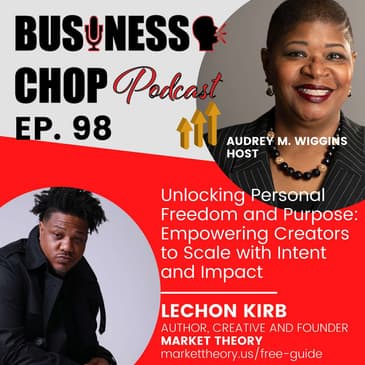


In this engaging episode, Lechon Kirb joins Audrey “Tech Diva” Wiggins to share his transformative journey from a pivotal childhood experience to becoming a multi-hyphenate entrepreneur, speaker, and creator of the Impact Scaling framework. He discusses how his upbringing, including the influence of his entrepreneurial mother and his time in the Marine Corps, shaped his drive for personal freedom and growth.
Lechon reveals that freedom, to him, is as essential as oxygen. This core value drives everything he does, whether it's building his business or helping others grow theirs. Through Impact Scaling, Lechon has empowered over 25,000 creators and businesses to scale purposefully, focusing on meaningful impact rather than just profits.
KEY TAKEAWAYS
Mindset is Key
Lechon emphasizes that mindset shapes your reality. He explains that many entrepreneurs get stuck in limiting beliefs based on their upbringing or environment. Shifting your mindset allows you to overcome obstacles and unlock new levels of success.
Freedom as a Core Driver
Lechon shares a life-changing moment from his childhood when he was trapped in a refrigerator, which sparked his intense desire for personal freedom. He now equates freedom to oxygen, underscoring its importance in both personal and professional life.
The Power of Relationships
Relationships are described as "master keys" that can open doors to new opportunities. Lechon highlights that genuine connections, built on curiosity and value, can elevate your business and personal growth.
Failure as a Learning Tool
Failure is part of the entrepreneurial journey. Lechon shares how, even after failures, he focused on what didn’t work, reassessed, and pushed forward. This ability to learn from mistakes instead of internalizing them as personal shortcomings is crucial to long-term success.
Impact Scaling vs. Traditional Scaling
Lechon’s Impact Scaling framework focuses on scaling in a way that aligns with personal values and makes a positive impact. He challenges entrepr
Start for FREE
Designrr for eBooks, Blogs
Create eBooks, Blogs, Lead Magnets and more!
Riverside.fm Your Own Virtual Studio
Professional Virtual Studio
Altogether Domains, Hosting and More
Bringing your business online - domain names, web design, branded email, security, hosting and more.
Digital Business Cards
Let's speed up your follow up. Get a digital business card.
Small Business Legal Services
Your Small Business Legal Plan can help with any business legal matter.
Get Quality Podcast Guests Now
Keep your podcast schedule filled with quality guests from PodMatch.
Disclaimer: This post contains affiliate links. If you make a purchase, I may receive a commission at no extra cost to you.
Please Rate & Review
Visit Our Parent Company Altogether Marketing LLC
Tech Diva Biz Talks is a business marketing and technology podcast exploring innovation, branding, and leadership. Officially indexed on IMDb (2021– ), the show reflects Audrey Wiggins’ work in media production and strategic communications. It is produced by her company, Altogether Marketing LLC. Learn more at altogether.biz.
[00:00:03] Welcome to the Business Shop Podcast, where I guess speak on meeting the challenges of entrepreneurship
[00:00:09] as well as offer tips and advice on business, marketing, technology and more.
[00:00:16] Whether you are a newbie or seasoned professional, this episode is for you.
[00:00:21] I am your host, Audrey Wiggins.
[00:00:25] Let's chop it up!
[00:00:27] Before we get started, quick shout out to Perry Mason, my cousin for the new music.
[00:00:32] What do you think? Leave me a comment! Find his music on Apple Music as well as Spotify,
[00:00:37] the SPER Live M-A-Blye, S-I-N, Perry Mason. Thanks, Trace, a love the new music.
[00:00:44] Hello, chop spot. Audrey Wiggins here, you know, as usual. I am excited to be with you.
[00:00:49] And I'm excited for our guests as always and so I want you to meet Lechon Kirb.
[00:00:55] Now, his friends call him Kirb. So we will see how the interview goes by the end.
[00:00:59] Perhaps we'll be friends. He's a multi-hive and creative entrepreneur, speaker and author with
[00:01:07] a passion for helping creators and entrepreneurs like us. Scale their businesses while staying
[00:01:13] tuned to their purpose. Now Lechon is the founder of Market Theory and the creator of the impact
[00:01:20] scaling framework, which is a powerful approach that has helped over 25,000 creators and businesses
[00:01:27] that she's an ability purpose-driven growth. He's also the author of a culture of equity,
[00:01:34] owning your purpose, redefining your narratives and amplifying your presence, where he
[00:01:40] empowers individuals to own their stories and create meaningful change. Now, on the other side
[00:01:46] of this message, we're going to hear more from and about Kirb.
[00:02:16] Now with Lechon and he is here to share his insights on everything from mindset,
[00:02:23] entrepreneurship, to creativity and building scalable systems. Let's dive in and learn how we can all
[00:02:31] take bold steps for building a business and life that truly aligns with our passion and our
[00:02:38] purpose. Welcome to the show, Lechon Kirb, aka Kirby. Thank you so much for having me.
[00:02:45] I don't want to be here. Yes, absolutely. As I've read in, I can't wait to share.
[00:02:50] You know, okay. All right. So right off to Rift, what was the pivotal moment in your life
[00:02:56] this spark you and drive for personal freedom and purpose driven growth? That's a great question.
[00:03:04] You know, I think for me it starts when I was a kid. First of all, I got to see my mom is an entrepreneur
[00:03:09] and she was doing some really, really amazing things like she had her own TV show and
[00:03:15] she was known to the music industry and she was who an American women. And even when I was
[00:03:20] young, she got inducted to the wall of tolerance by Rosa Parks. So she was doing some really amazing
[00:03:26] stuff. But there was one pivotal moment for me, I think, when I was around six years old,
[00:03:33] I was playing high and go seek my mom's house one time, my sister and my cousin. And essentially
[00:03:39] my cousin and my sister went to go hide upstairs. I got the the bright idea of going to hide
[00:03:43] in the basement. My mom had this old refrigerator down there and I took out the racks, the quantum
[00:03:48] refrigerator, and while I was trying to get situated, I knocked it over on the door. So now I'm trapped
[00:03:54] in there and I'm clawing and I'm screaming, I'm gasping for air. And obviously, I'm freaking out.
[00:03:59] Eventually, nothing noise that my mom came and found me. Kick the thing over, got me out of there.
[00:04:04] But that was like the moment that I felt like I needed freedom like I needed oxygen. There's
[00:04:10] the same thing to me. And that became kind of like the catalyst between why I moved so
[00:04:18] fiercely toward freedom. And I'm so passionate about sharing that with people. Because it's really
[00:04:22] like the same type of thing you need to be able to have that oxygen in your life and what does that
[00:04:26] look like? It always amazed me how something negative or tragic or traumatic, it could be the catalyst
[00:04:33] to our success or just push us forward with the drive like nobody's business.
[00:04:39] Yeah, it's no motorator like necessity. You know, like I need this.
[00:04:43] I have a big driver for me. Yeah, oh my goodness. Yeah, that was I imagine I was scary.
[00:04:50] He's was like, I don't want to die here. I mean, if you never even had the photos like
[00:04:55] there, there would termination just was to move forward, you know, get out and get moving. So
[00:04:59] like, you know, I'm weird. I was going to say like a scenario like that is scary, right?
[00:05:07] And you why it's so powerful is because you're you're face to face with your fears.
[00:05:14] And you don't have a choice with the face at that point. And when you do, you find that in
[00:05:20] in many cases, it is critical for you to have that capability to face whatever your concerns are,
[00:05:26] whatever your fears are. It doesn't matter if you're afraid to do something or not.
[00:05:31] It really requires you to do it anyways, you know, in order to embrace that courageousness in your
[00:05:38] life. So yeah, tragic could have been much more tragic, you know, dramatic definitely
[00:05:44] one of the many things though. So it all kind of like ties together.
[00:05:48] And your bio, you don't mention this. But I want to ask you about being in the Marine Corps
[00:05:52] and this is a, I'm just still going along that same thing about personal freedom,
[00:05:57] a nonchibinorship. And how did that play a big part of your story?
[00:06:01] The Marine Corps is it's such a playing field for growth, for sure.
[00:06:09] Because of my already primary drivers for freedom and all that since I was young,
[00:06:14] that is the perspective that led me to the Marine Corps, right? It was like I wanted to get
[00:06:20] that for myself. It was like the first time I got my own place and had my own money and was able
[00:06:25] to do certain things. So I went in so young, you know, but you learned a lot of things in the
[00:06:28] Marine Corps and you're pushed up against fears, concerns, challenges there. But greater than
[00:06:34] everything, your forges into something different. You are forced to realize that it requires you to be
[00:06:42] greater than the person that you've known yourself to be in order to achieve incredible things.
[00:06:46] And that resonance, that frequency of being in the Marine Corps, I think translates into entrepreneurship,
[00:06:53] 100% but yeah, I gained a lot from being in the Marine Corps traveling the world, meeting people
[00:06:58] from all kinds of different backgrounds and that kind of thing learning different languages, you know,
[00:07:03] is definitely a powerful thing if you want to move around in the right ways in this life.
[00:07:08] Absolutely. And thank you for that period of time. Thank you for your service as well.
[00:07:13] Yeah, thank you. Yes, you are so welcome. What is the biggest lesson you've learned about balancing
[00:07:19] personal freedom with business responsibilities? The biggest lesson I've learned about all of it
[00:07:26] is that it all has to do with your mindset. How you see things is literally the reality that you
[00:07:33] live with it. It doesn't make it the entire reality but it's certainly the way that you experience
[00:07:37] it. Like if you grow up in a poor neighborhood and you obtain the belief that you are nothing,
[00:07:43] you are lesser, you know, that creates a certain outcome for you and in fact, I might keep you
[00:07:50] in that environment and keep you staying in that environment. You know, so mindset for me,
[00:07:55] I think it's the catalyst, the connector that moves me in and out of all of these different
[00:08:00] kinds of worlds in certainly entrepreneurship. That's the biggest lesson because it doesn't
[00:08:04] really matter if you do something that you attempted to do something and you fail, right? Like
[00:08:09] I failed many, many, many times. I've had some wins but I failed many times. I never made myself
[00:08:14] the source of the failure. I was always able to take what happened, look at it, break it down and say,
[00:08:19] okay, well, what didn't work about this? You know, did it not have the right resources,
[00:08:23] did it not have the right people, did it not go about it the right way? It was the wrong timing.
[00:08:28] And then I can go back and apply some more energy toward that thing. So being able to do that,
[00:08:33] I think it's really powerful if you want to be successful at anything. Can you go a little deeper
[00:08:37] into the personal story about the time that you did face a major setback and how you turned that
[00:08:42] around? Just, you know, take that impact that a little bit more about what you just shared with us.
[00:08:46] Yeah, well, I've had a ton. You know, I think that entrepreneurship is like for people on the outside,
[00:08:53] they never owned a business or they never tried to start a business. There you are,
[00:08:58] you are faced with your fears also, right? Because if you don't have a safety net,
[00:09:04] you literally, like everything that you need, even down to your phone bill and your power,
[00:09:08] like what feeding your kids, like you need to be able to figure out how to get some momentum
[00:09:13] into to create some sustainability there. And it's very difficult to do, especially at the early stages.
[00:09:19] And if you don't really get that, you're going to really struggle. Okay. And I did too,
[00:09:26] because I didn't come from this environment where I knew, like, I didn't get all the,
[00:09:31] all the messages about business and I didn't know the tactics about finance. And I didn't know
[00:09:37] like all these different things. I didn't get those things even when I went to school. So it's
[00:09:42] what did I have that was a big failure? Well, I'll tell you this because there's many, but
[00:09:48] I originally set out to like create my own business and probably like 2011. And I'm
[00:09:55] originally was like photography and that kind of thing. I got good at doing photography. Great.
[00:10:00] I didn't know anything about clients or marketing or any of that. And I didn't really get
[00:10:04] how that connected. There was one particular time that I had gotten really kind of, I would say
[00:10:11] some success in terms of notoriety in the photography branding space. And that campaign got picked
[00:10:17] up by the Universal BET centric. And it was getting like kind of pushed all over the world,
[00:10:22] many, many millions of trends. But you know impressions and things like that. And I wasn't
[00:10:26] really making any money. And I was like, wow, you can have these large organizations using your
[00:10:32] creativity, your own campaigns, your own billboard, your own magazines, and also simultaneously
[00:10:37] not making any money from it. And I felt like I needed to know how do you connect those dots?
[00:10:43] I knew that people were, I didn't know what's happening. I was like, yeah, I was sensing
[00:10:47] is it was something else. It's somebody funding them or these grants. Like, how are they making
[00:10:52] the money? Because that's the thing that I needed to get to the next step. And that thinking helped
[00:10:59] me get to the next step. It was like, I need to figure out how this works. I had a friend though.
[00:11:04] I met around shortly after that who was like really, really successful in the software space.
[00:11:10] I had like a really successful business in the hair care software space. And we were in this
[00:11:17] conversation this one time. And in that conversation, they really highlighted a lot of things I
[00:11:24] never considered. One was that I asked him, how do you have this super successful software company?
[00:11:29] And you don't know how to do any software. In fact, you were an orphan. You didn't even come from
[00:11:33] any, you didn't come from that background. You didn't get those skills. His response was like,
[00:11:38] I don't need to know how to do software. I need to know people who know how to do software.
[00:11:43] You know, which was like a complete, I had never had that shift prior to that. I was like, oh,
[00:11:48] wow, I don't have to be the source of all the things to know and all the things to do. I need to
[00:11:53] have access to it, which is a completely different mindset. And he said to me, you know, if you start to
[00:11:58] figure out how you can make money in your sleep, then you will stop trading your time for dollars.
[00:12:05] Prior to that conversation, I had never considered people who were making money in their sleep.
[00:12:09] I certainly didn't know how, but the question of how, let me down a whole different rabbit
[00:12:15] holes like, okay, well, how are people doing that? What are the steps? Is this a real thing?
[00:12:19] That would never have questioned for me at that time. So it definitely changed my outlook.
[00:12:23] I picked up on a couple things. There's a court questioning the process one and relationships
[00:12:29] and understanding collaboration, those types of things. You want to want to speak to that?
[00:12:35] Honestly, and I'm thank you for listening in that way. You know, I'm glad that you could hear
[00:12:39] that under my language. I believe very strongly in relationships because, or from one,
[00:12:44] they've been very powerful in my life. Second is that, man, the right relationship is a
[00:12:50] master key for you. Like there are doors that you can enter that you wouldn't have been able to
[00:12:59] resources. There's skills that you have access to that just live in the form of being kind to
[00:13:05] to someone. It's an unlikely candidate to be your friend. You know, so I feel very strongly about
[00:13:10] the power of relationships because I've seen them open doors for me. Like, I've so many different
[00:13:15] things. But one thing that stands out to me is like, I got invited to the Grammys a few years back.
[00:13:20] And when people see me doing that, they're like, but how? Like, I don't get it. Like, I was invited
[00:13:25] to the Grammys. You're not even in music. I was like, well, I have friends in music. I have friends
[00:13:31] in music. And that is been like a really kind of the kind of energy that I've taken into
[00:13:37] everything that I do. The power of relationships is incredible. If you don't have the credentials,
[00:13:42] even if you have the credentials and you need it, the right cosine, you need the right introduction,
[00:13:46] you need people to look at you in the right level. All of that can be leveraged off of the
[00:13:51] relationship. This makes you think that when it's to be full-time at entrepreneurship and being a
[00:13:56] member of the Chamber of Commerce, so you do meet a lot of people. You may even have conversations
[00:14:01] that I would look back on and I'm like, how do I leverage those relationships? And so that was
[00:14:09] that's powerful. Sometimes we do have people in our network and not just on the outer realms,
[00:14:15] the outer circle, but sometimes a little closer. And we have no idea how to, you know,
[00:14:20] just start the right conversation or any conversation to go up to that person because I think
[00:14:25] sometimes we're so an eye, you know, we're putting the person up on a pedestal, which means
[00:14:31] we're demeaning ourselves or, you know, kind of sending our own selves and that, and that
[00:14:36] relationship. Yeah, there's something to me said about levers. I want to touch on that a little bit,
[00:14:41] right? Because it's my view that most people attempt to leverage certain things,
[00:14:46] try or through the development of that particular thing and people fail at this in relationships
[00:14:51] all the time. Right? Where I found it to be most powerful is for you to be incredibly curious
[00:15:00] and truly genuinely interested in connecting with people. I got this either by adaptation,
[00:15:07] maybe it was natural for me. I don't know. I went to probably 14 different schools before I
[00:15:12] got out of high school and why that was helpful for me is because it was like kind of a revolving
[00:15:18] door of faces, but it was also a revolving door of like people. You know, I was I started to
[00:15:24] gain this skill to be able to remove the things that normally get in a way of a conversation and
[00:15:29] move them out of the space. And sometimes that's your fears, sometimes that's your concerns, that's
[00:15:35] the way that you feel you need to present yourself. If you can just move all of that out of the
[00:15:41] way when you're connecting with people, you have this ability to connect faster. If you're
[00:15:47] genuinely curious, you're genuinely interested. You want to know, you really want to get it. It
[00:15:53] just becomes a multiplier with the way that you're able to develop your relationships. Now sometimes
[00:15:58] that lives in a conversation, it's like, what can you do for me? Okay, fine. But that what
[00:16:05] can you do for me changes a lot when you already have a sense of what that potential relationship
[00:16:11] is facing? What problem can you solve for them? Is that a high value problem? Does that create
[00:16:16] something in their life that gives them access to something that's of great value? If so,
[00:16:21] that's not a longer leverage. That's something that you're doing that's removing a pain point
[00:16:27] you'll find that people are very happy to become your friend when you're able to do that.
[00:16:31] Because then it becomes a win-win and not just coming in trying to pot off or show off your
[00:16:37] products and services to sell what they're interested in, what they're doing and that's just
[00:16:41] part of the sales person. Well, they're just not going to care. They're not going to care unless
[00:16:45] you give them a genuine reason to care. Why should I care? Because even if paying attention to you
[00:16:51] requires me, you trade every other thing I could be doing in my life. That time that energy
[00:16:57] that focus, like I need a wash it I care. You have to give me that reason. You have to make it
[00:17:01] clear why I should care and I don't mean getting on the thing and a pedestal and saying, you know,
[00:17:07] more than that kind of thing but if you make it clear, like wow, this is what I'm here for.
[00:17:11] This is a context and you're genuinely there for that. It makes it powerful. It's a powerful
[00:17:18] exchange. Knock out your competition with all together marketing. We elevate your brand. Take a
[00:17:26] name logo, the jack line, your colors. Even the fonts for your business and then jack left
[00:17:33] for your website, jack right with core values. Back up with product experience and bring it on with you.
[00:17:41] Those are all together. That is and let us help you create a knockout brand. Kirby for someone who's
[00:17:49] struggling, you know, to find your purpose and what's your advice for taking those first steps towards
[00:17:54] your life in the personal and professional. That's a great question. I love that question by the way.
[00:18:00] Because I think most people try to dial their purpose into a purpose, right? First is like
[00:18:08] a resonance or vibration. What kinds of things really connect with you? What are you interested in?
[00:18:14] Because that will let you know what's going to be like the path of least resistance for you.
[00:18:19] Because it opens up everything else. Because if you're genuinely leaning into the direction of
[00:18:25] your interest, you're going to find relationships there. You're going to find people making money there.
[00:18:30] You're going to find fun there in a natural flow state that you can lean into.
[00:18:35] And I am of the belief that you can create freedom through any of those things.
[00:18:41] You know, if it's something that you're passionate about, other people are probably passionate
[00:18:44] about that thing, then you just create a new world for yourself, a new atmosphere for yourself,
[00:18:49] by leaning into it. Now there aren't frameworks and things that you can use that can make it
[00:18:53] palatable for you if you're like an entrepreneur or you're trying to make it make sense for you.
[00:18:57] Finally, there are ways to do that. And we can talk about that too. But I think the best thing to do
[00:19:03] is to not trap yourself into a specific purpose because you might have many different purposes.
[00:19:09] You wouldn't have layers upon layers of purpose. But to lean into the things that really
[00:19:15] resonate with you, interest you and find yourself curious about how to engage with those things.
[00:19:21] And you mentioned frameworks and things like that on the impact scaling.
[00:19:25] You know, what's funny about impact scaling is that when people talk about scaling in general,
[00:19:31] usually they're just saying, I want to make more money. Yeah.
[00:19:39] Do I need to run fair and stir? And that kind of thing, which is great. It's okay. But I think
[00:19:45] digging a little deeper on that generally speaking, they want to make more money to gain access
[00:19:53] to something. They want to spend more time with their kids. They want to take their parents
[00:19:59] and get them in a new house. They want to move overseas. Like they want to leverage the money
[00:20:04] into something that's going to buy them, the life that they truly desire. And it's not usually
[00:20:12] a transactional thing. Sometimes people are front facing it looks like it's transactional,
[00:20:17] but they're trying to get something and maybe they're in to do intense about it, whatever.
[00:20:21] But what I like about impact scaling is that it allows you to think in terms of not only just
[00:20:28] scaling aspect, but how that truly impacts your audience, your family and yourself, your
[00:20:34] true, your true desires. Like really making all of those things connect. Whether that's your
[00:20:40] finances, your relationships, your health, your mindset, your spirituality, like talking about a
[00:20:47] holistic way that you integrate all the things that do matter to the the map of your life in
[00:20:53] general and making that work in a scalable way. So for us, that is helping to take what you're
[00:21:01] passionate about, your knowledge, your skill sets and all that, in creating scalable products.
[00:21:06] That could be online courses. That could be memberships. That could be paid communities around
[00:21:11] specific interests. And then what are the tools that you used to do that? Are they digital
[00:21:16] products? Are they on my marketing tools? What do you need to have to make it work? And that's
[00:21:20] me helping people do? Yeah, that's awesome. This is a great time to have this conversation
[00:21:24] to as you're coming in the fourth quarter, set in our sales for success in the new years of
[00:21:29] that's great. So let's talk about your book, Harvey, a culture of equity, emphasizing owning
[00:21:34] your narrative. So how can we take control of our stories and maybe how do we even want
[00:21:39] me like sometimes won't even know what our story is? Great question. Well, nobody knows your story
[00:21:44] better than you. Like, you know, like well I have this experience, you know, if you ever
[00:21:49] have experience like pulling that person's story out of them, and maybe we tell our story,
[00:21:54] maybe we don't know that's what it is. That's true. That's very, very true. Where I think is powerful
[00:22:01] about a culture of equity, at least the intention behind it. Most people get involved with something
[00:22:05] because they got enrolled to do so. And that could be the school that they went to, the job
[00:22:10] that they're doing, the business, and that kind of thing that they're doing. But what I find is that
[00:22:16] once they do that, most people don't get the same energy out of it that they put in. Right?
[00:22:23] Like they don't get the resources that they should have gotten out of it. If they help a business
[00:22:29] grow substantially, usually they're not an equity partner and that like they're not going to be
[00:22:34] a part of the exit. You know, they're not going to be a part of the energy that they put in.
[00:22:38] So the book is really guiding people to really be able to take inventory of the value that you bring
[00:22:45] to something. Like the true value, not just like how you feel about it, but like what is the value
[00:22:52] of it? Like what is it now worth? What are they going to be able to do with it now? And how can you think
[00:22:57] about your contribution in a way that allows you to have a sense of what you should be getting
[00:23:04] in terms of equity? And that definitely starts with like how you value your own contribution
[00:23:10] and what that really means for what you're doing. And being able to communicate the value that
[00:23:17] you do have in a way that's very powerful because to your point, if you don't understand
[00:23:22] for yourself how valuable you are and why that is so instrumental for any organization that you're
[00:23:29] involved with, it's very hard to tell someone else why you want you learn what they should
[00:23:33] give you in response. Right? So I love it for that because it has people take inventory of
[00:23:39] really mapping out what that is for them. Well Kirby, where can we get your book and tell us about
[00:23:44] your website? Well we can find what we get there. Yeah so the book is going to be releasing
[00:23:49] Q1 this next year. So that's in the works. It's an editing process where we're you know,
[00:23:56] refining it. But if you want to connect with me, yeah, you can go, you can visit our website
[00:24:00] just mark at theory.us and you can find me online anywhere in Instagram linked in any of that
[00:24:08] Sean Kirby. And I'm happy to connect, I'm happy to share with you anything that I can do
[00:24:13] to be helpful. We also have like a free guide that I think is really helpful for experts,
[00:24:19] consultants, speakers, people that want to really get their voice out there and it has a bunch of
[00:24:24] frameworks in there how you can do that, how you can monetize that experience, how you can grow your
[00:24:29] email lists and all that kind of stuff. Things that are going to help you really expand yourself,
[00:24:33] make yourself more scalable and stop training those time for dollars. So we have a free guide
[00:24:37] we offer there. So that's just market theory.us forward slash free hyphen guide. Now as you come to
[00:24:42] a close Kirby, what advice or nugget that you want to just lay on us? Yeah I think the biggest
[00:24:50] nugget I want to lay onto everyone is that we tend to be engaged with technology at a very low level,
[00:24:57] most people do like for example right now like people are using AI, find it, right? But I don't
[00:25:03] think what they get is is that if you're able to multiply yourself by 100, what could you do in
[00:25:09] that time frame? What could you do? Right. So how can you take these technologies? How can you take
[00:25:14] and harness the time to really leverage everything else that you don't need to do so you can create
[00:25:19] the life that you love? But if you look back even just 20 years ago it looked very different for
[00:25:26] how people use their cell phones. That's true. 10 years before that look very different for how
[00:25:30] you use the internet. People weren't even convinced that you could make money on the internet.
[00:25:34] Now there are a billion dollar companies being made on the internet. So I would invite everyone who
[00:25:38] is just they really feel like they have something they want to get out there to really embrace
[00:25:44] technology right now because it's speeding up which is one and everything you're doing is an
[00:25:50] exchange for every other thing you could be doing. So if you can harness that energy to speed up
[00:25:55] the progress of your own desire, like really be able to bring that in, you're going to get to where
[00:26:00] you want to get that much faster because you're able to multiply yourself. You're also able to
[00:26:05] reduce the time that it takes you to get there. So I would say be open to the technologies around
[00:26:12] embrace them, use them to multiply yourself, multiply your intentions, your efforts, your messages
[00:26:18] and use that to get yourself to the life that you desire way faster than the people that came
[00:26:23] before us were able to do it. Kirby that was amazing. Chapsquad you have got to the follow-curve
[00:26:29] Lashon Curve, get to his websites and connect with him on social media and take the heart
[00:26:35] the information that he's given us today. And until then we'll see you next week.
[00:26:40] Thank you for having me. You are absolutely welcome.
[00:26:59] Business shop.info or else, at www.bus where we will help you expand your brand.
Resources
Some of the resources here are affiliate links. We may receive a small commission if you buy or subscribe. It does not affect the price you pay.

BUZZSPROUT. The best way to launch a professional podcast.
RIVERSIDE.FM. Professional Remote Content Creation Studio

DESIGNRR. Get Instant Transcripts from your Podcast, Video, or Webinar

ALTOGETHER DOMAINS. Online Solutions for Domain Names, Hosting, Website Security, Email Marketing & more